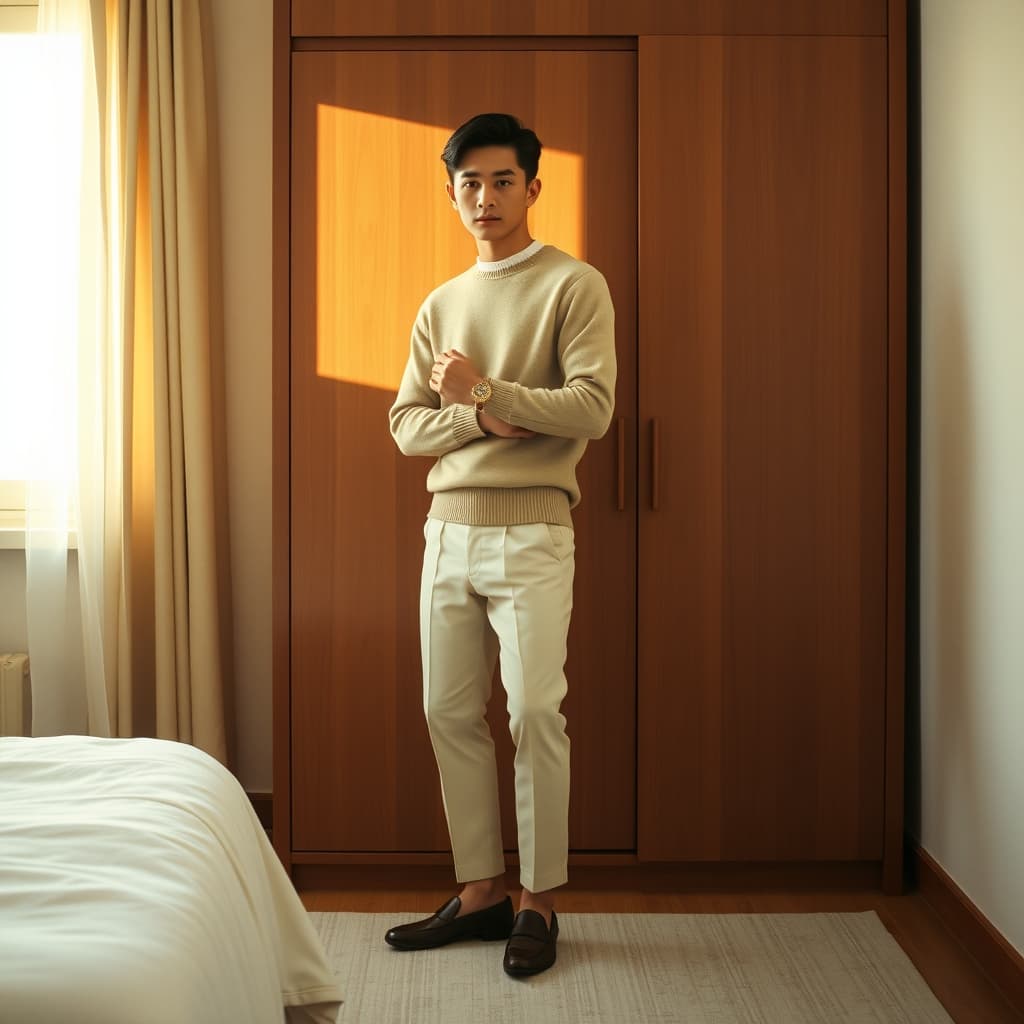
There is a small and now well-documented pattern in behavioural research called ego depletion. The short version: the mental muscle you use to make choices gets tired. It gets tired quickly. And it does not distinguish between the choice of what to have for breakfast and the choice of how to handle a difficult conversation you have at eleven.
Barack Obama famously wore the same two suits every day so he did not spend his willpower on clothing before he needed it for foreign policy. Steve Jobs did the same, more visibly. Zuckerberg turned it into a personal brand. The bit of the story that gets missed is that none of them started from nothing. They started from a wardrobe they had made a decision about, once, so that they could stop making it every day.
What decision fatigue actually costs
It is easy to hand-wave this as a productivity nicety, but the research is more interesting than that. A study of parole judges in Israel showed that the probability of a favourable ruling dropped from about 65% at the start of a session to nearly zero by the end, and reset after breaks. The judges were making better decisions when their willpower was fresh, and worse ones when it was not, and they did not know it.
Whatever your morning ends with, whether it is a meeting or a school run, the you that arrives has already made about fifty small choices before you got there. Toothpaste, temperature of the shower, coffee or tea, oat milk or normal, which podcast, which route, which shoes. Each one is small. Each one costs a little. Compound that across a week and the cost is real.
Why the wardrobe is where this hurts most
Clothing is unusual among daily choices because it is both frequent and visible. You cannot skip it, you cannot outsource it, and there is a low-grade anxiety attached to getting it wrong. You will be seen. In a way, the pressure to get it right is the tax the choice pays every morning.
The best time to choose an outfit is when it doesn't matter yet.
Five ways to move the decision earlier
1. Plan tomorrow the night before, on the sofa
Two minutes. You already know the weather forecast. You already know what your day looks like. The exercise takes less time than choosing what to watch on television, and it means the morning has one fewer thing in it.
2. Pick a weekly uniform on Sunday
Not identical outfits every day, that would be exhausting in a different way. Pick a rotation of five combinations that suit your week, note them somewhere, and then in the morning your only job is to check which one you're up to. If you rotate two trouser types, two knits and two shirts, that is thirty-two combinations from six pieces. You will not need thirty-two.
3. Set an occasion default
For each register you actually use, name a default. "When I have a client meeting, I wear this." "When I'm doing a school run, I wear this." You will still deviate sometimes; that is fine. But the default removes the moments where you stand in front of the mirror, changing three times, and you never quite know why.
4. Cut the surface area
If your rail has 120 things in it, your morning has 120 choices in it, even if you never open half the hangers. Move the pieces you do not wear this season into a box. The wardrobe you look at should contain only the pieces that are eligible for today, and today has weather.
5. Photograph it, then let an app do the sorting
A wardrobe that lives in your phone can be searched. "Warm, casual, works with brown boots." You do not have to remember which of your three navy jumpers is the one that fits well, because the app remembers for you. This is the case FitMatch makes for itself, but the general point holds even if you use a spreadsheet.
The bigger claim, quietly
You do not owe your morning your best thinking. The point is not to become a person who wears the same thing every day, unless that is a choice that suits you. The point is to spend your willpower on the parts of the day that need it and to hand off the parts that do not.
A well-planned outfit is not vanity. It is a small piece of infrastructure. When it is in place, you get to spend your morning on the things that actually change the day.